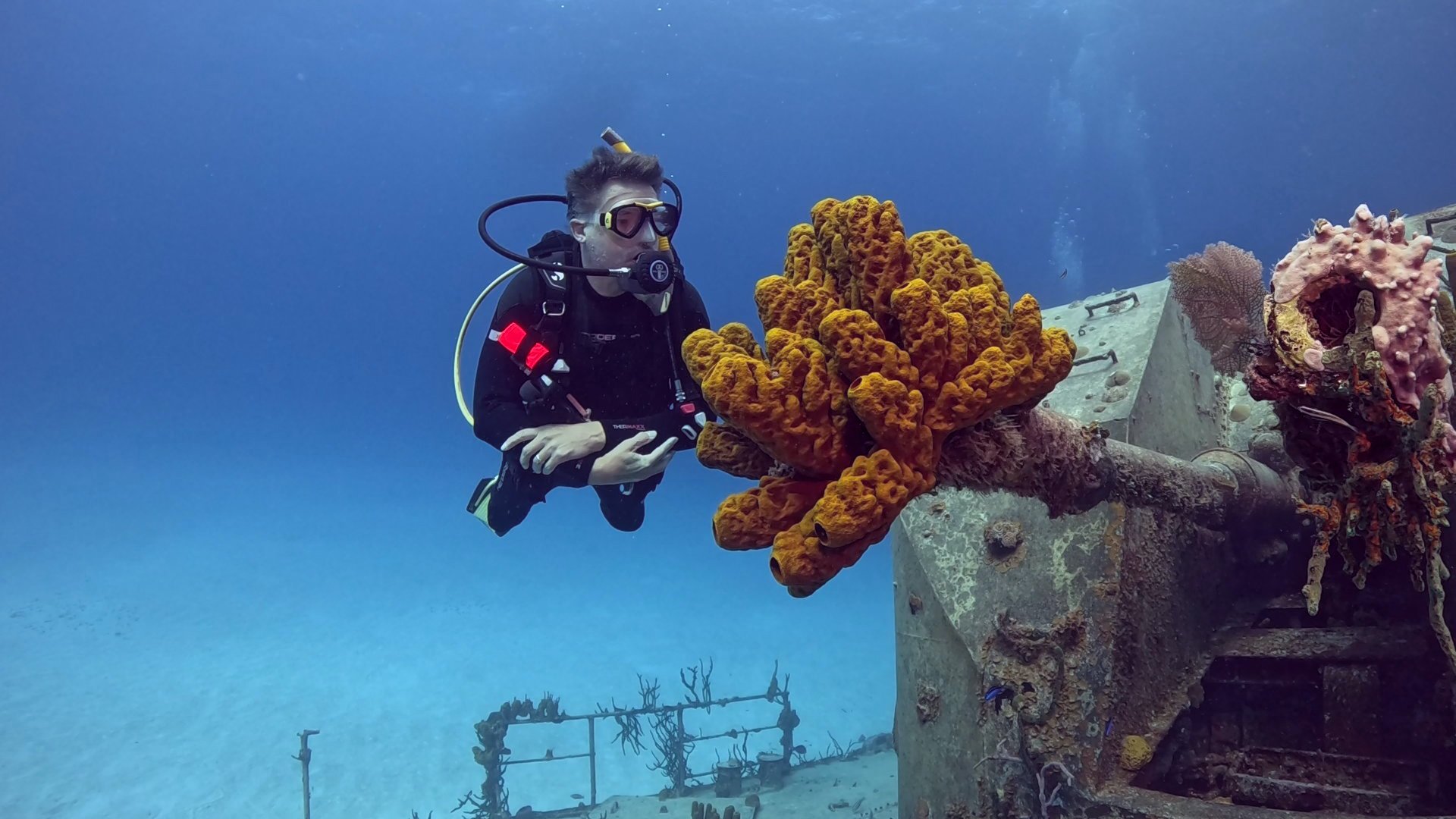
Just got back from a week of great diving in Cayman Brac. A seemingly odd topic for a photography blog; but there is a method that I hope will make sense.
Buoyancy is the great equalizer in SCUBA. Weightlessness (neutral buoyancy) in water, while laden with heavy gear, is the ultimate goal. I have seen overweight divers, divers with injuries and disabilities, and older divers become soaring birds… or more appropriately, perfectly balanced fish. There are some tricks to learning good buoyancy. Some divers get the hang of it very quickly; others always remain clumsy, heavy, and off balance underwater. There is often an “ah ha moment”. And, like all skills, it requires practice, patience, and repetition. Good buoyancy is the gateway to many other important aspects of diving like minimal air consumption, streamlined posture, preserving delicate sea life by staying off the bottom, situational awareness, good buddy skills, and an enhanced overall experience. It is when diving becomes meditative. I have good buoyancy, under most circumstances.
During the trip I took my camera and lights under water for several dives. My rig is fairly simple, small, and light. Every time I dive with camera gear I recall a week of diving very early in my SCUBA and science career. Hard diving, deep diving, far offshore in cold water, my first Nitrox dives, and wearing double tanks with redundancy and a bulky drysuit. Additionally, there were multiple tasks and scientific activities to perform on every dive. I was a novice in the deep end. Bill Curtsinger, a renowned underwater photographer, joined the team and dove with my group on a few dives. Bill was slight, kept to himself, and was task oriented. His rigs were large housings holding advanced 35 mm film cameras, they had big dome ports, and double strobes on large articulated mounts. Something akin to space ships or giant deep-water arthropods. He slipped effortlessly over the side of the rubber boat with three of these rigs hanging by tethers from his gear. Perfect buoyancy and complete control in challenging conditions. He was a marvel.
On my recent dives with a camera rig, I once again felt like a novice. My buoyancy suffered dramatically. I used more air. I lost track of my buddy (grateful for 100 feet of visibility) more than once; and generally failed at task loading. On land it is common to become myopic while pursuing a photograph or series of images. But underwater the stakes are higher and the mistakes more obvious. Returning to the boat I commented to the captain and divemaster that I was shocked how much air my camera used.
The experience is a valuable reminder about becoming complacent, presumptuous, and forgetting the value of important early lessons. There is always room for improvement, learning from others, acquiring new skills, and humility. Zen is a never-ending pursuit.
Photo by Chris DeCarlo